
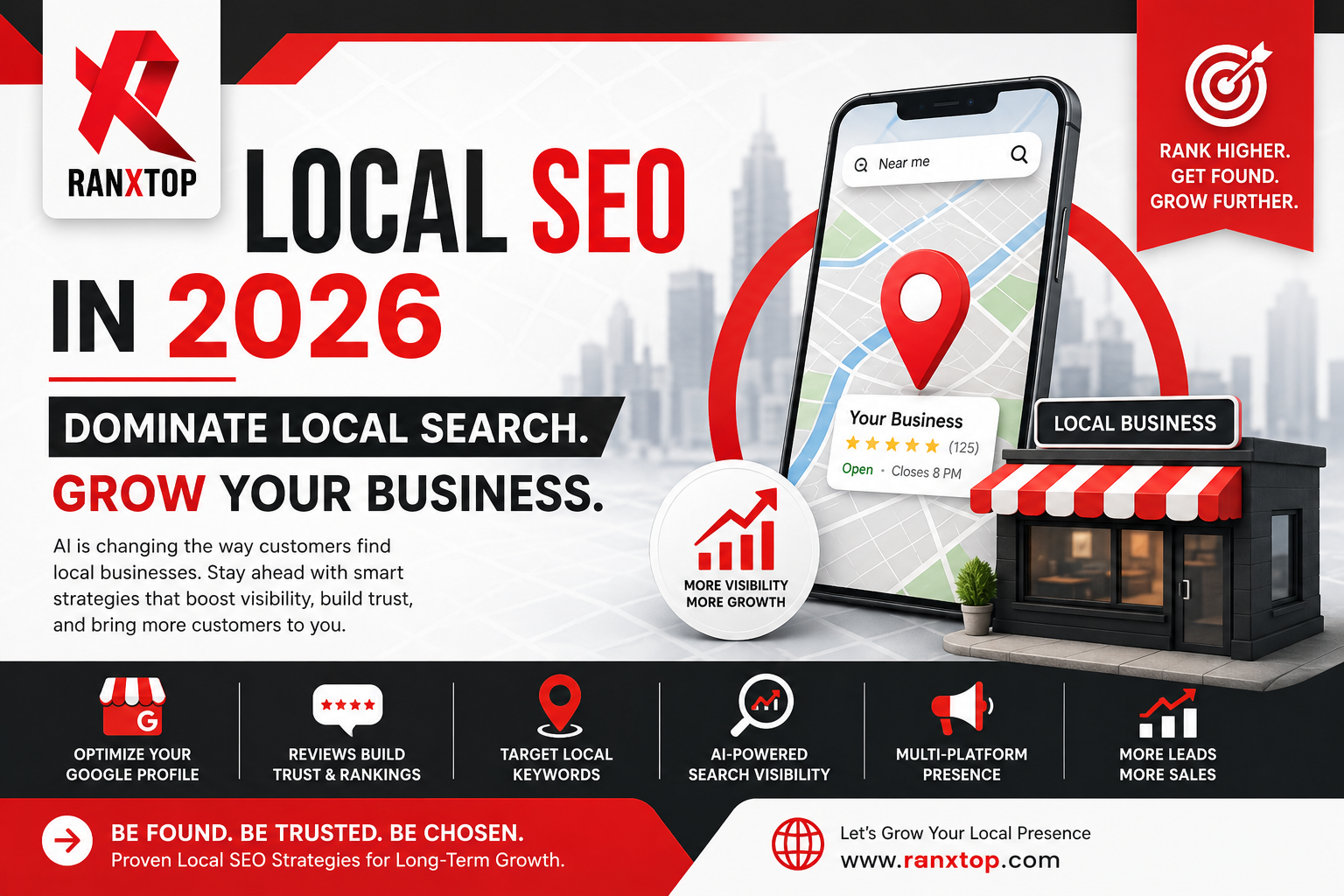
Local SEO has changed more in the last eighteen months than it did in the previous five years. If you’re still treating “local SEO” as a checklist of citations and a few keyword-stuffed pages, you’re already behind. In 2026, local search success is decided by how well AI systems, not just Google’s algorithm, understand and trust your business. For businesses working with ranxtop.com, understanding this shift is the difference between showing up when someone nearby is ready to buy — or disappearing into an AI-generated answer that never mentions you.
This guide breaks down what’s actually trending in local SEO right now, the keywords and strategies that matter, and how to build a local presence that holds up in an AI-first search world.
The Trending Shift: AI Is Now the Local Search Engine
The single biggest local SEO trend of 2026 is the move from “ranking a website” to “being understood as a trustworthy entity.” Google has reported that AI Overviews are now used by more than a billion people and are available in over 200 countries and 40-plus languages, which means a growing share of local search journeys start — and sometimes end — inside an AI-generated summary instead of a traditional list of blue links.
At the same time, discovery itself has fragmented. Customers are increasingly finding businesses through AI assistants, Instagram, and TikTok rather than typing a query directly into Google Maps. A person searching for a local service might ask an AI chatbot for a recommendation, scroll a short-form video review, or ask Gemini directly — long before opening a search engine tab.
Two more shifts are reshaping the competitive landscape:
- Paid placements are eating organic space. Mobile local results are increasingly dominated by paid ads and Local Services Ads, squeezing organic visibility for businesses that haven’t diversified their presence.
- Trust signals now matter more than volume tactics. Search engines increasingly treat businesses as real-world “entities” rather than just websites, which means consistency in your business information carries more ranking weight than ever.
For any business trying to win local visibility in 2026, the strategy has to account for all of this at once: AI Overviews, social discovery, paid competition, and entity trust.
Core Local SEO Keywords Businesses Should Target in 2026
Keyword strategy hasn’t disappeared — it’s evolved. Alongside traditional terms like “near me” searches, businesses should now build content and profiles around:
- Local intent keywords — “[service] in [city/neighborhood],” “best [business type] near [landmark]”
- Conversational and question-based keywords — phrases that mirror how people talk to AI assistants (“who does the best plumbing repair in [city]?”)
- Micro-market keywords — hyper-specific neighborhood or district terms rather than broad city-wide phrases
- Trust and review keywords — “[business name] reviews,” “is [business] good,” “[service] recommendations”
- Category-specific service keywords — precise service categories that match how Google Business Profile categorizes your listing
The takeaway: keyword research should now be built for how people ask questions, not just how they type them.
How to Actually Dominate Local Search in 2026
1. Treat Your Google Business Profile Like a Homepage
Your Google Business Profile has become a primary data source for AI-driven local results, functioning almost like a second homepage for your business. That means:
- Keep categories accurate and specific rather than broad
- Post updates and photos regularly, the way you would on a social feed
- Respond to every review and question consistently
2. Prioritize Review Content, Not Just Review Volume
Star ratings alone no longer tell the full story. AI systems now evaluate the actual language inside reviews to check whether customers mention the specific services a business wants to rank for, and the vast majority of consumers now read reviews before deciding whether a local business is credible. Encourage customers to mention specific services by name in their reviews — it directly feeds how AI systems describe your business to potential customers.
3. Nail NAP Consistency Everywhere
Name, Address, and Phone number consistency across your website, directories, social profiles, and citations remains foundational. As search engines increasingly treat businesses as verified real-world entities, identical NAP data across every platform is a core trust signal.
4. Win Your Micro-Market, Not Just Your City
Local SEO in 2026 is shifting away from broad city-wide category ranking toward micro-market dominance — winning a specific neighborhood or district rather than trying to own an entire metro area. Build location pages, content, and Google Business Profile posts around specific neighborhoods, landmarks, or districts rather than generic city-level targeting.
5. Diversify Beyond Google
Since visibility increasingly depends on diversifying across platforms like YouTube and Reddit rather than relying solely on organic Google rankings, businesses should actively build a presence on the platforms their customers actually use to discover local options — short-form video, community forums, and niche local directories included.
6. Publish Genuinely Human Content
Success in the current environment favors unique, human-written content over generic AI-generated text. Detailed, specific, locally-relevant content — written by people who actually understand the business and its customers — is what stands out in an AI-saturated content landscape.
7. Optimize for Answer Engines, Not Just Search Engines
Because search engines are shifting from providing lists of links to giving direct answers, local businesses now need to help AI systems understand and trust their information rather than simply optimizing for rankings. Structure your website content in clear, direct-answer formats (FAQs, concise service descriptions, structured data) so AI systems can easily extract and represent your business accurately.
Why Local SEO Still Matters in 2026
Despite the disruption, local search hasn’t lost its power — it’s simply gotten more competitive and more complex. Google and Google Maps still play a central role in how people discover nearby businesses, even as social platforms become a bigger part of the research journey, and strong local visibility continues to drive calls, website visits, bookings, and foot traffic quickly. The businesses that adapt to AI-driven, multi-platform discovery now will be the ones still visible — and thriving — a year from now.
FAQs
1. What is the biggest local SEO trend in 2026? The biggest shift is the rise of AI-powered local search. AI Overviews, chatbots, and AI-driven Maps results now summarize and recommend businesses directly, so ranking well depends on being understood as a trustworthy, well-documented entity — not just having a keyword-optimized website.
2. Do I still need a Google Business Profile in 2026? Yes, more than ever. Your Google Business Profile is now one of the primary sources AI systems pull from to describe and recommend local businesses, so it should be treated as seriously as your website homepage.
3. How important are online reviews for local SEO now? Extremely important. It’s not just about star ratings anymore — AI systems analyze the actual wording in reviews to determine which services a business is genuinely known for, so encouraging detailed, specific reviews is a real ranking factor.
4. What are micro-market keywords and why do they matter? Micro-market keywords target a specific neighborhood, district, or landmark rather than an entire city. As local search becomes more competitive, winning a tightly defined local area is often more achievable — and more valuable — than chasing broad city-wide rankings.
5. Should businesses still invest in traditional SEO content, or focus only on AI optimization? Both. Traditional SEO fundamentals like NAP consistency, quality content, and site structure still matter, but they now need to be paired with answer-engine-friendly formatting and genuinely human, specific content that AI systems can accurately understand and cite.
Looking to build a local SEO strategy tailored to your market? Ranxtop.com helps businesses navigate the AI-driven local search landscape with strategies built for 2026 and beyond.